University|04-11-2026
Online Abuse in the Metaverse
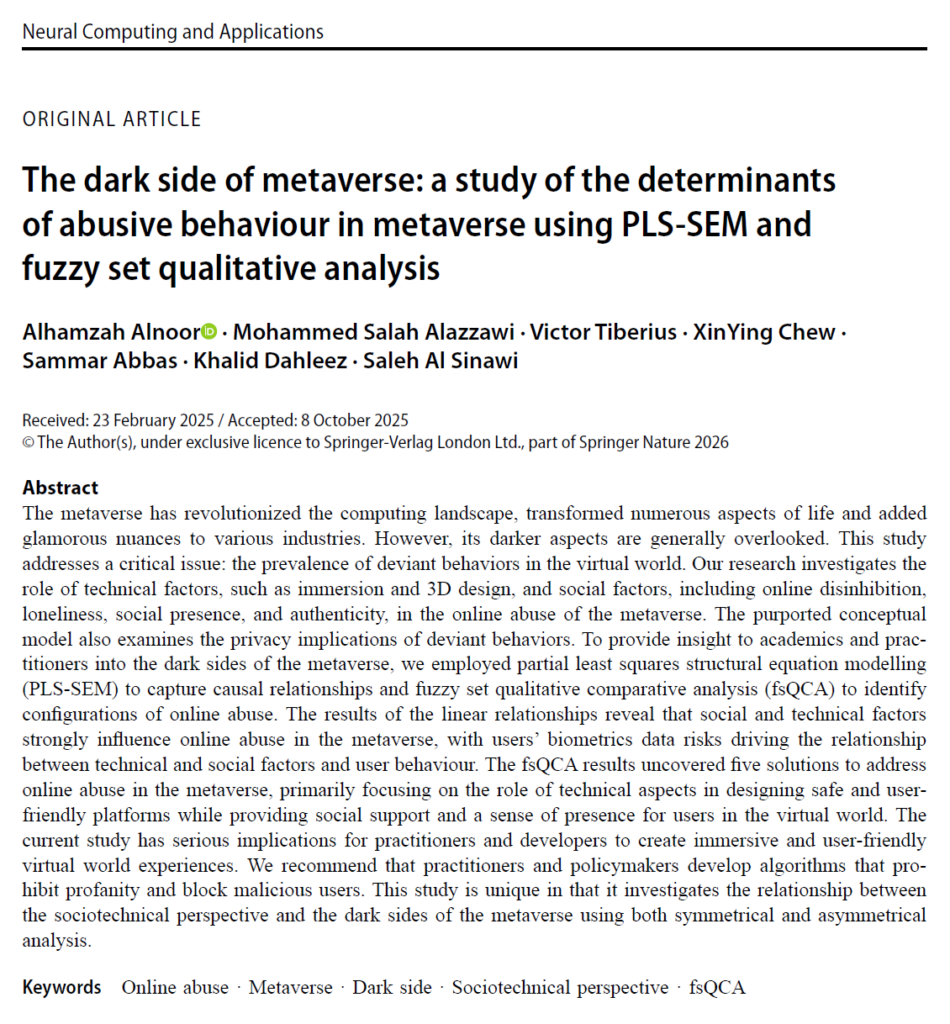
Our new study in Neural Computing and Applications examines what drives online abuse in the metaverse. Based on data from 1,313 Malaysian VR users and using PLS-SEM plus fsQCA, we find that psychological factors such as online disinhibition, loneliness, and social presence, together with technical factors like immersion and 3D design, shape abusive behavior through biometrics data risk.
Compared with our earlier study in IJHCI, which focused more on social ties, homophily, as well as general privacy and security risks, this paper shifts attention to psychological states and the specific role of biometric data risk. All direct and indirect effects were significant. Loneliness and social presence showed the strongest indirect effects on abuse.
A central result is that low online disinhibition appears in every configuration associated with less abuse. Immersion also emerges consistently as a protective factor. For platforms, the implication is clear: reduce disinhibited behavior, strengthen biometric data protection, and invest in immersive, well-designed environments.
Abstract:
The metaverse has revolutionized the computing landscape, transformed numerous aspects of life and added glamorous nuances to various industries. However, its darker aspects are generally overlooked. This study addresses a critical issue: the prevalence of deviant behaviors in the virtual world. Our research investigates the role of technical factors, such as immersion and 3D design, and social factors, including online disinhibition, loneliness, social presence, and authenticity, in the online abuse of the metaverse. The purported conceptual model also examines the privacy implications of deviant behaviors. To provide insight to academics and practitioners into the dark sides of the metaverse, we employed partial least squares structural equation modelling (PLS-SEM) to capture causal relationships and fuzzy set qualitative comparative analysis (fsQCA) to identify configurations of online abuse. The results of the linear relationships reveal that social and technical factors
strongly influence online abuse in the metaverse, with users’ biometrics data risks driving the relationship
between technical and social factors and user behaviour. The fsQCA results uncovered five solutions to address online abuse in the metaverse, primarily focusing on the role of technical aspects in designing safe and user-friendly platforms while providing social support and a sense of presence for users in the virtual world. The current study has serious implications for practitioners and developers to create immersive and user-friendly virtual world experiences. We recommend that practitioners and policymakers develop algorithms that prohibit profanity and block malicious users. This study is unique in that it investigates the relationship between the sociotechnical perspective and the dark sides of the metaverse using both symmetrical and asymmetrical analysis.
Quelle:
Alnoor, A., Alazzawi, M. S., Tiberius, V., Chew, X., Abbas, S., Dahleez, K., & Al-Sinawi, S. (2026). The dark side of metaverse: a study of the determinants of abusive behaviour in metaverse using PLS-SEM and fuzzy set qualitative Analysis. Neural Computing and Applications, 38, 266. doi:10.1007/s00521-025-11794-2